Pages

Showing posts with label pelvic varicose veins. Show all posts

Friday, 22 February 2013

TalkHealth 6th March - Mark Whiteley on pelvic veins

Mark Whiteley is one of the experts on the Talk Health Gynaecology Clinic to be held online on 6th-12th March 2013.

The research from The Whiteley Clinic into pelvic varicose veins (pelvic congestion syndrome) and after pregnancy vulval and / or vaginal varicose veins is now starting to gain national and international recognition.

Mark Whiteley on "Talk Health" on 6th March

As a consequence, Mark has been ask to join this discussion to answer queries about varicose veins, vulval and vaginal varicose veins and pelvic vein during and after pregnancy.

Details about the "Talk Health" event:
http://www.talkhealthpartnership.com/online_clinics/online_clinic_on_gynaecology_2013.php

Thursday, 21 February 2013

Varicose veins in Pregnancy - Vulval and vaginal varicose veins

Varicose veins in pregnancy, and particularly the varicose veins in the pelvis causing vulval and vaginal varicose veins after pregnancy have been a speciality of The Whiteley Clinic for over a decade.
Babyworld website - Click on the picture above to read the article
Today Babyworld has published an article about the troublesome veins and the treatments that have been pioneered by The Whiteley Clinic.
http://babyworld.co.uk/2013/02/a-new-treatment-for-varicose-veins/

Wednesday, 26 September 2012

Recurrent varicose veins - pelvic venous reflux is ignored by most

Alice Whiteley is one of two Whiteley Clinic Summer Research Fellows who have had their research selected for presentation at The Medical Acorn Foundation (National Medical Student Research Conference) in Leicester on 13th October 2012.


Alice Whiteley - The Whiteley Clinic Summer Research Fellow 2012
Presenting her research into the cause of recurrent varicose veins operated on elsewhere 
Alice spent her summer analysing the results from patients seeking help from The Whiteley Clinic having had varicose vein surgery elsewhere and then getting recurrent varicose veins.

She identified the causes of their recurrent varicose veins, and found that pelvic venous reflux is one of the major causes, a problem that has previously been ignored.


Alice's research presents powerful evidence for why the pelvic veins need to be scanned and, if refluxing, treated, to reduce the risks of recurrent varicose veins in the future.

Her work has been submitted for an American meeting next year and will be submittied for UK vein meetings next year, before submitting for publication.


Left varicose veins caused by Pelvic vein reflux
seen as para-vulvar veins on examination

Right varicose veins caused by Pelvic vein reflux
seen as para-vulvar-veins on examination

Pelvic and para-vulal varicose veins:  www.vulval-varicose-veins.co.uk
 
Medical Acorn Conference:  www.themedicalacornfoundation.org/


Sunday, 22 April 2012

Warning - Varicose veins coming from Pelvic Veins

This lady, who presented to The Whiteley Clinic with varicose veins, typifies a problem that we are seeing very commonly.

Although her varicose veins appear to be in the legs, when she was scanned by the expert Vascular Technologists at The Whiteley Clinic, it was found that all of her underlying leg veins were normal - and all of the visible varicose veins come from "hidden varicose veins" in the pelvis.
Left leg varicose veins - however scan showed the underlying causes was from Pelvic Veins only. Surgery to the leg varicose veins (Stripping, Laser, Radiofrequency, etc) would NOT have worked
Had this lady gone to a normal varicose vein clinic or seen a normal varicose vein surgeon, she would have more than likely had her normal leg veins treated (by stripping, laser, radiofrequency or foam sclerotherapy).

Using The Whiteley Protocol, our patients have a scan that identifies exactly where the vein come from - and we don't make any assumptions. Hence most of our scans take some 40 minutes or more (unlike most venous scans that are rattled off in 10 minutes or so - missing more difficult patterns like this).


Varicose veins down the backs of both legs - however scan showed the underlying causes was from Pelvic Veins only. Surgery to the leg varicose veins (Stripping, Laser, Radiofrequency etc) would NOT have worked.
The successful treatment of women with this sort of pelvic venous problem starts off by identifying it.

Pelvic vein problems almost always occur in women who have had at least on baby by normal vaginal delivery. Very occasionally the problem can be found in women who have had caesarian sections - and very rarely in women who have not had childbirth, or in men.

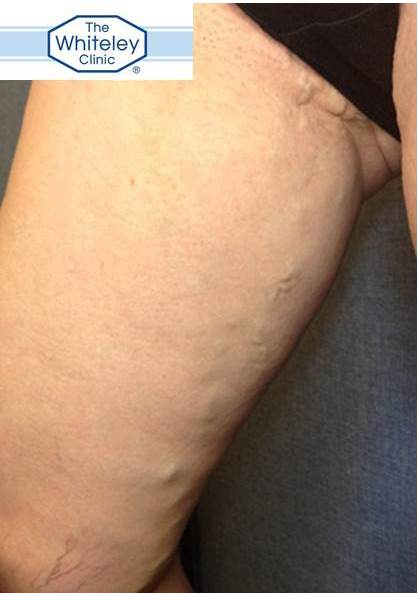
Visible veins on the upper inner thigh, next to the vulva, shows that pelvic veins are probably involved.
One of the "tell-tale" signs are women who have veins at the top and inner side of their thighs, next to their vulva (para-vulval veins) as above.

A pelvic duplex ultrasound scan performed by one of our experts then shows which veins are involved, directing treatment by X-ray, through a pin-hole only.

Once the pelvic veins are treated, the bulging veins on the legs can then be treated, knowing that the chance of them coming back again is minimal.

However, if a woman with this problem had undergone surgery using normal techniques (such as stripping, laser of radiofrequency) the veins would return very soon after treatment, as the underlying pelvic veins would have been missed. Unfortunaltely, this is what usually happens and is one of the reasons that so many women get their veins back again after treatment elsewhere.

For more information please see: www.vulval-varicose-veins.co.uk